I am writing an open textbook on robot learning, Foundations of Robot Learning: Scaling Learning for Real-World Agents. The first two chapters are now online as drafts at robotlearningbook.com, each next to the slides and lecture recordings for the same topic.
Why write a book
Robot learning moves quickly, and the material for learning it has not kept up. A student who wants to enter the field today pieces it together from lecture slides, recorded talks, blog posts and a growing pile of papers, each written for a different audience and with its own notation. Slides are terse by design, and papers assume the reader already knows the twenty papers that came before. There are good textbooks on reinforcement learning and on classical robotics, but few that treat learning for robots as one subject, from imitation learning through deep reinforcement learning to large foundation models.
I want to provide better source material for people learning robotics: one place, in one consistent notation, that explains not only what each method does but why it was needed and where it still fails. The book is free to read for students at any institution and for practitioners who are not enrolled anywhere.
What is in the first two chapters
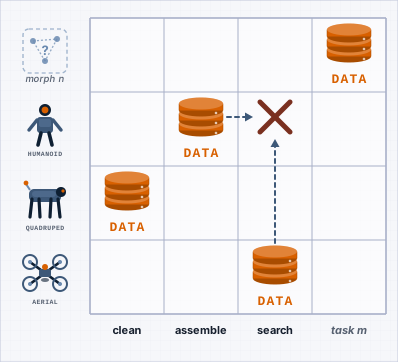 Chapter 1: What Is Robot Learning? The first chapter starts with an honest look at where robots stand today. Robots are already common in manufacturing, warehouses and hospitals, but they work there because the environment is engineered to tolerances that make adaptability unnecessary. The chapter argues that learning is what closes the gap between these brittle, pre-scripted systems and the robots we actually envision. A useful way to picture the goal is a grid of tasks by robot bodies, where each row is a robot such as a humanoid, a quadruped or a drone, and each column is a task such as cleaning, assembly or search. Today, most data and most policies cover single cells of this grid, and transferring a skill from one cell to another is hard. A generalist robot policy should instead perform well across the whole grid.
The chapter then sets up the notation used throughout the book (states versus observations, the Markov property, policies and trajectories), and surveys the three main paradigms: learning from demonstrations, autonomous learning with deep reinforcement learning, and model-based methods. It closes on the questions that motivate the rest of the book: how to find representations that generalize, where the data comes from, and whether reinforcement learning can be fed enough experience to scale.
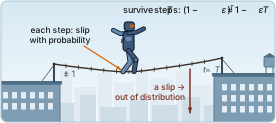 Chapter 2: Supervised Learning and Imitation Learning. The second chapter asks whether a simple recipe, observing what experts do and copying them, can serve as a foundation for general robot learning. It traces imitation learning from ALVINN in 1988, through large-scale systems such as BC-Z and RT-1, to today’s vision-language-action (VLA) models, which build on pretrained vision-language models and are trained largely by imitation learning on large collections of robot demonstrations. The chapter also explains why the simple recipe breaks. The simplest form of imitation learning, behaviour cloning, is like walking a tightrope: at each step the policy slips with some small probability, and a single slip takes it into states the expert never visited, where the training data offers no guidance. Staying on the rope for a whole task becomes less likely the longer the task, and the total cost grows quadratically with the task horizon.
From there, the chapter covers the main fixes and why each was needed: DAgger for distribution shift, scale and data diversity for spurious correlations, diffusion, variational and autoregressive models for multi-modal demonstrations, and action chunking to shorten the effective horizon. Action chunking also matters for VLAs, whose large models can take half a second or more per prediction, too slow for a control loop running at 50 Hz unless the model predicts many actions at once. The chapter finishes with learning from demonstrations without action labels, inverse dynamics models, inverse reinforcement learning and adversarial imitation.
How the book is made
The content comes from my Robot Learning course (IFT 6163) at Université de Montréal and Mila, and in particular from the slides, lecture notes and recordings of the past three years. The slides fix the order of topics, the figures and the mathematics. The recordings capture what the slides leave out: the intuition behind an equation, the reason one method replaced another, and the examples that only come out when answering students’ questions. I use AI tools to turn many hours of transcribed lectures into first drafts that follow the slides, and then I read, correct and revise every chapter myself. Because the book is built from the same material I update each time I teach, improvements to the course flow back into the book. The How This Book Is Made page has more detail.
Read it and send feedback
These are drafts, and the remaining chapters on reinforcement learning, planning, goal-conditioned learning and foundation models for robotics will follow as they are ready. You can read Chapter 1 and Chapter 2 online or download them as PDFs. If you find a mistake, an unclear explanation or a missing reference, please let me know. Every correction improves both the book and the next offering of the course.