Montreal Robotics Summer School (2026)
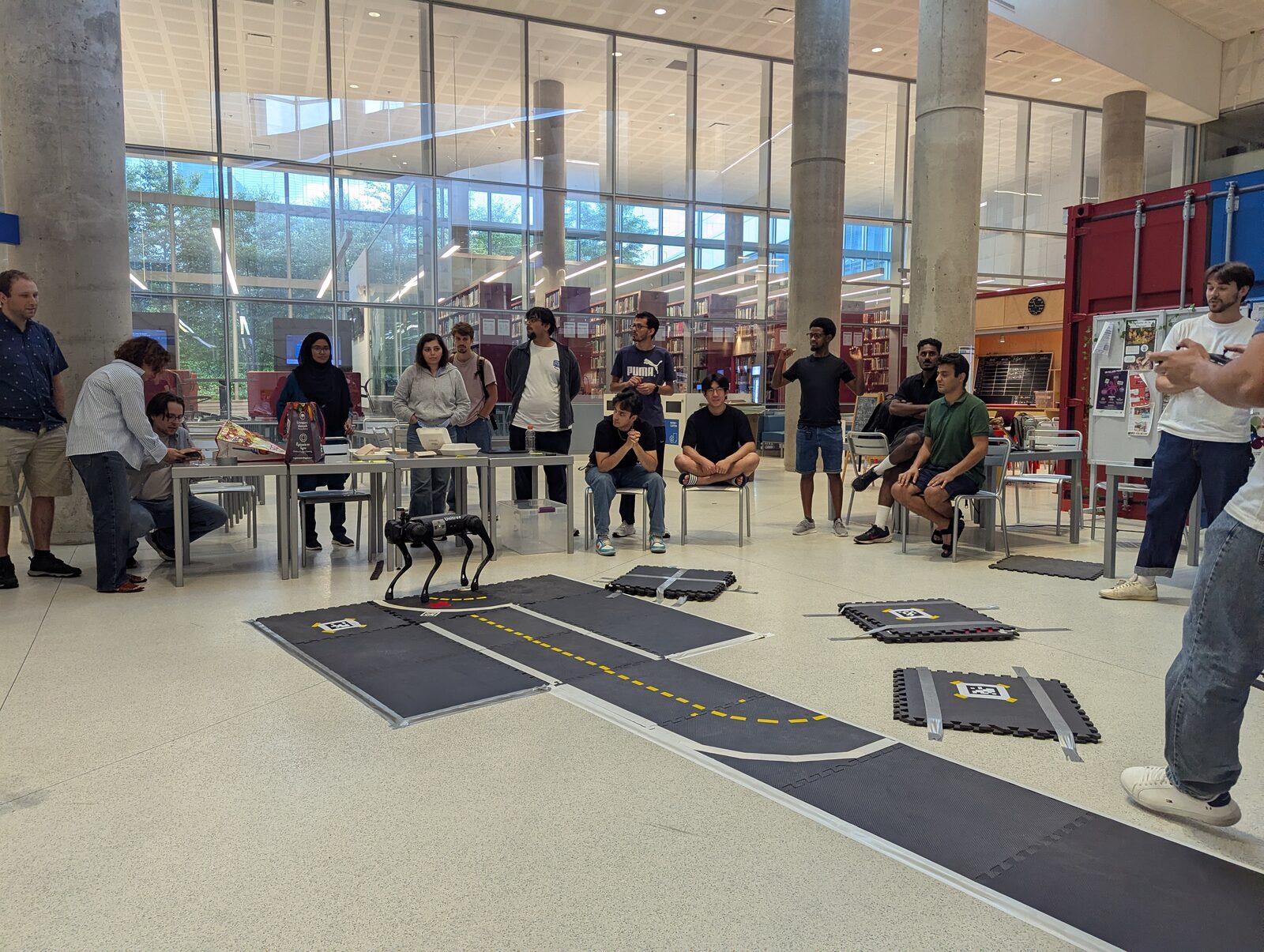 | 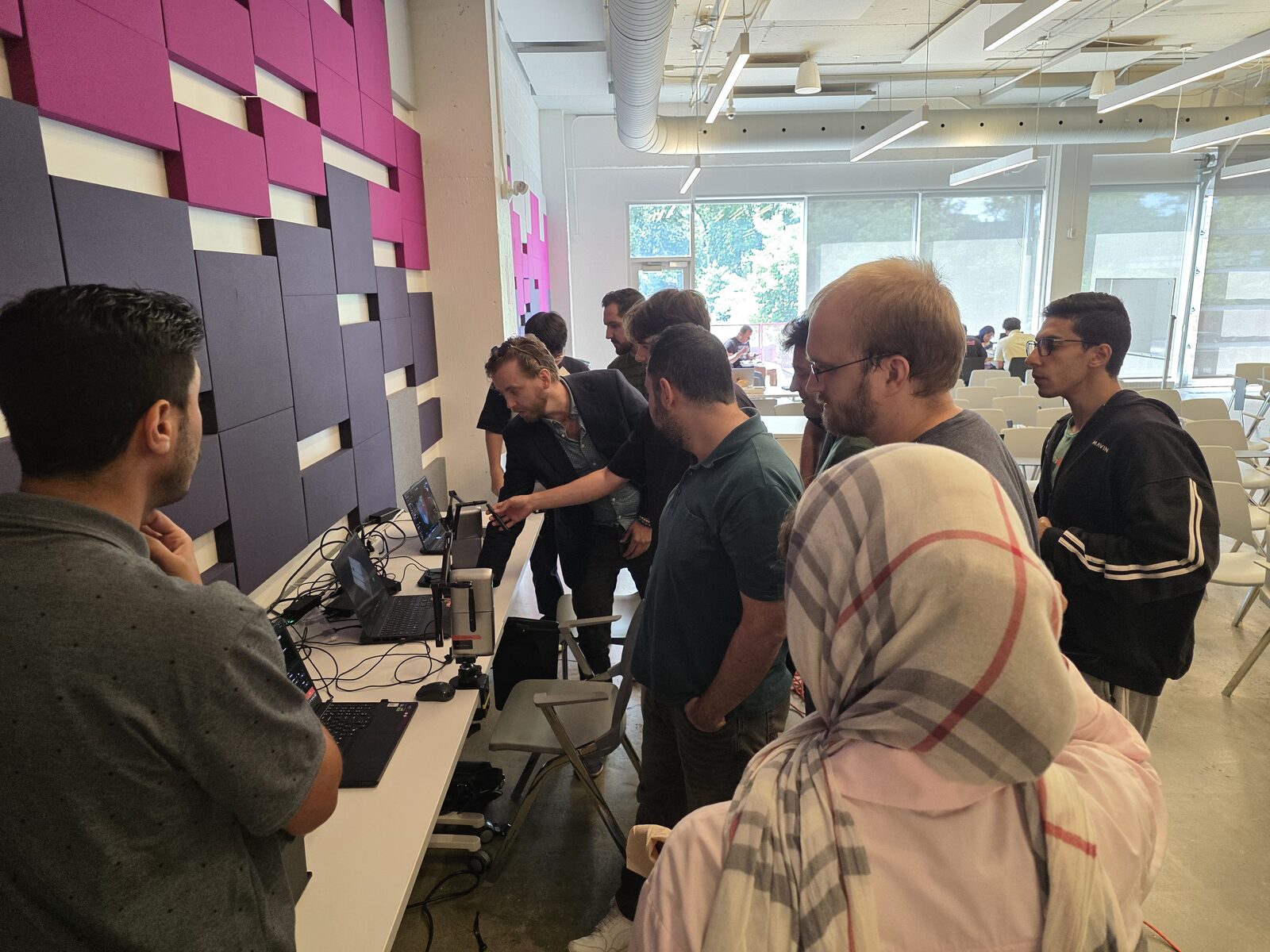 | 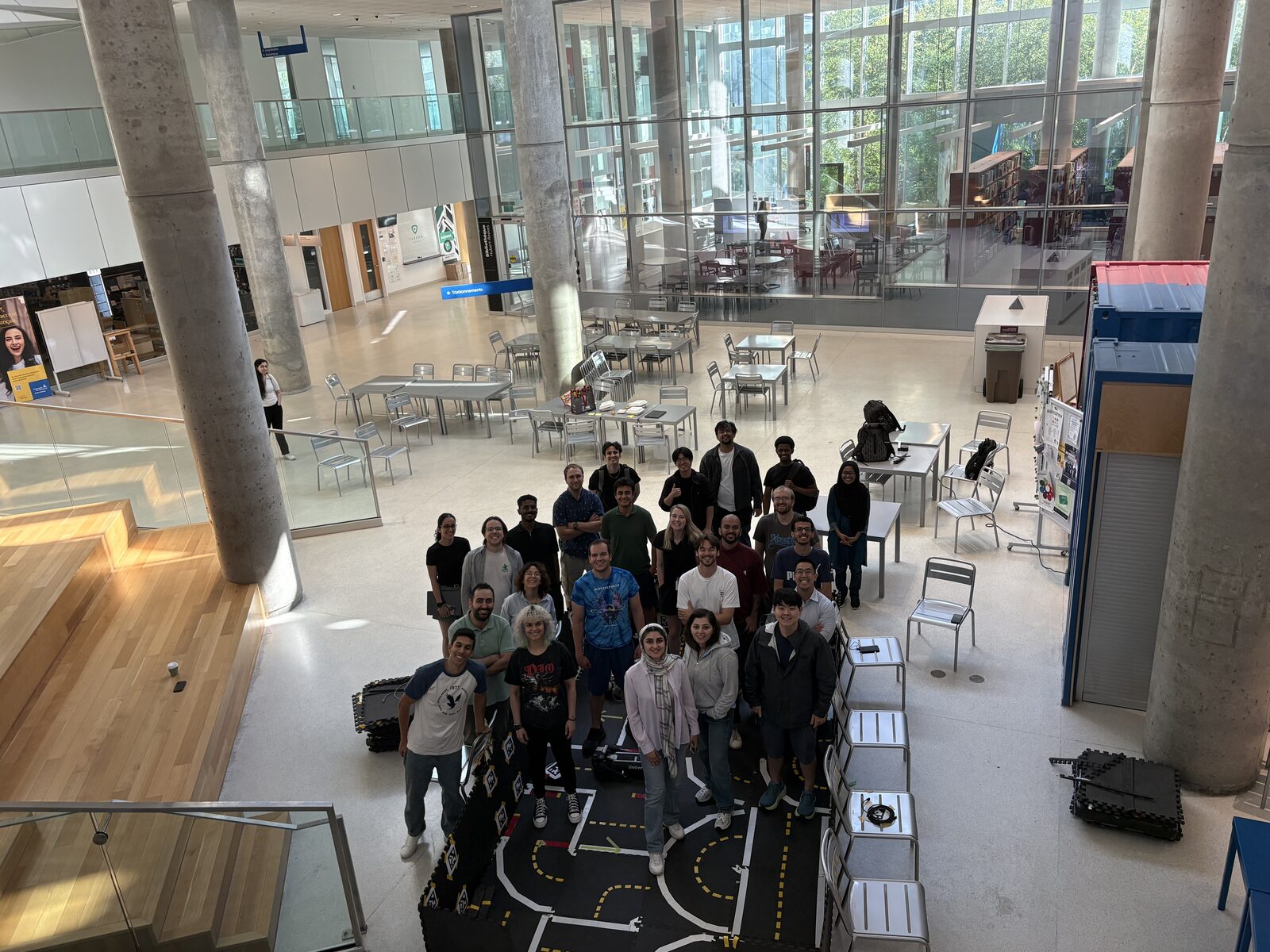 |
| Watching Fido run the course | Getting excited | The full 2026 cohort |
The Montreal Robotics Summer School (MRSS) ran August 9–14, 2026 at Mila, the Quebec AI Institute. Another cohort of graduate students spent a week going from first principles to real hardware: state estimation, perception, manipulation, planning, and reinforcement learning for sim2real transfer, all building toward a final-day robot challenge.
This Year’s Challenge: Bonne Appétit — Feed the Robot Dog!
This year’s challenge put a Unitree Go1 quadruped (“Fido”) to work: the robot had to walk itself to its dog bowl. Teams of up to four students designed, trained, and deployed policies to get Fido there, choosing their own methodology for locomotion and navigation.
The competition, held on Friday, scored teams across three tiers of increasing difficulty:
- Walk Forward (1 pt) — Reach the bowl in a straight line on flat terrain using manual joystick control, scored on speed and straightness.
- Obstacle Course to the Bowl (2 pts) — Navigate rough terrain and obstacles to the bowl, still under joystick control, scored on stability.
- Autonomous Hunt for the Bowl (3 pts) — Traverse the same obstacle course without joystick control, using only the Go1’s front-facing monocular fisheye camera and AprilTag detection to find the bowl on its own.
Each team got three runs, with their best score in each tier counting toward the final tally. The core technical challenge mirrored real robotics practice: train a robust low-level walking policy in simulation with Isaac Lab, transfer it to the physical Go1, then layer a vision-based navigation controller on top.
Overall Winners: Team 5 (Mahsa Hasheminejad, Michael Jenson, SayedHamid Bahreini, Zekai Jin) and Team 6 (Mohamed Nabail, Mohamed Samir, Rodrigo Murillo Aranda) topped the overall standings, each podiuming across multiple tiers.
Full per-tier results:
| Tier | 1st place | 2nd place | 3rd place / Honorable mention |
|---|---|---|---|
| Tier 1: Walk Forward | Team 3 | Team 4 | Team 5 |
| Tier 2: Obstacle Course | Team 1, Team 5 (tie) | Team 6 | Team 3 |
| Tier 3: Autonomous Hunt | Team 6 | Team 5 | Team 3 (honorable mention) |
What Students Learned
The week combined lectures, tutorials, and hands-on hardware time on Unitree Go1 quadrupeds and Locobots:
- Introduction to reinforcement learning and sim2real transfer
- State estimation and Kalman filtering, SLAM (MSCKF, GTSAM/iSAM2)
- Deep learning and computer vision for perception
- Trajectory optimization and imitation learning for manipulation and locomotion
- Robot manipulation
- Foundation models for robot control
- Legged locomotion and hardware programming
- Planning and design review for the final challenge
Speakers
MRSS 2026 brought together faculty and researchers spanning robot perception, manipulation, legged locomotion, state estimation, and learning-based control:
- Glen Berseth — Université de Montréal & Mila
- Serena Booth — Brown University
- Hsiu-Chin Lin — McGill University & Mila
- Ali Ayub — Concordia University
- Pierre-Yves Lajoie — Polytechnique Montréal
- James Forbes — McGill University
- Giovanni Beltrame — Polytechnique Montréal
- Philippe Nadeau — ÉTS (incoming)
- Tabitha Edith Lee — Université de Montréal
- Jesse Silverberg — Université de Montréal
Sponsors
- Renesas
- Haply
Organizing Team
- Glen Berseth
- Christopher Yee Wong
- Pierre-Yves Lajoie
- Kirsty Ellis
- Nicolas Fleury-Rousseau
- Soma Karthik
- Simon Roy
- Maëva Guerrier
- Olivier Lessard
- Special thanks to Mila for the space, and to everyone who volunteered hardware and design-review time throughout the week.